Document 018 sections
AI use policy, working draft
Written by the people who will own it.
A hands-on working session for managing partners, COLPs and heads of department. Your leadership team drafts the firm's AI use policy, classifies how AI is used today, and leaves with a 90-day rollout with a name against every action.
Written by the people who will own it.
Every real use, classified: log it, sign it off, or stop it.
Short enough to fill in. Reviewed by a named person.
Establish, embed, assure. A person and a date on every line.
“You remain accountable for all work and advice delivered to clients, whether or not AI has been used.”SRA warning notice, Misuse of AI
Freely available generative AI tools “are not capable of conducting reliable legal research.”Ayinde v London Borough of Haringey [2025] EWHC 1383 (Admin), para 6
Uploading confidential documents to an open tool is “to breach client confidentiality and waive legal privilege.”UK v Secretary of State for the Home Department [2026] UKUT 81 (IAC), para 60
“The human who relies on its use bears the responsibility for the accuracy.”Elden v HMRC [2026] UKFTT 41 (TC)
Every authority above is checked against its primary source and sits behind the workshop's three rules. Check currency before relying on any of them.
Fee earners are using ChatGPT, Claude or Copilot today, mostly out of sight. Careful people avoid it and careless people misuse it. This morning replaces that with rules everyone knows.
Most of the morning is your leadership team working, not listening. By the break the policy is drafted. By the end, every action has an owner and a date.
These are pages from the actual materials. The workbook arrives with your firm's name on it; the deck uses examples from your own pre-session answers.
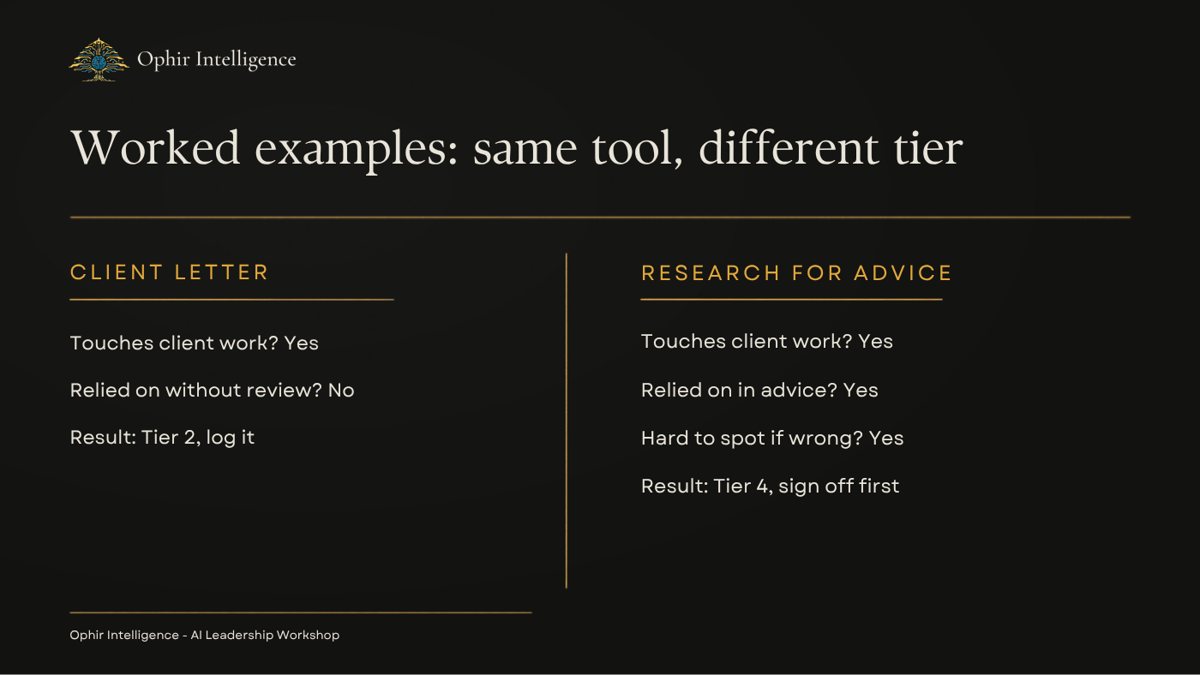
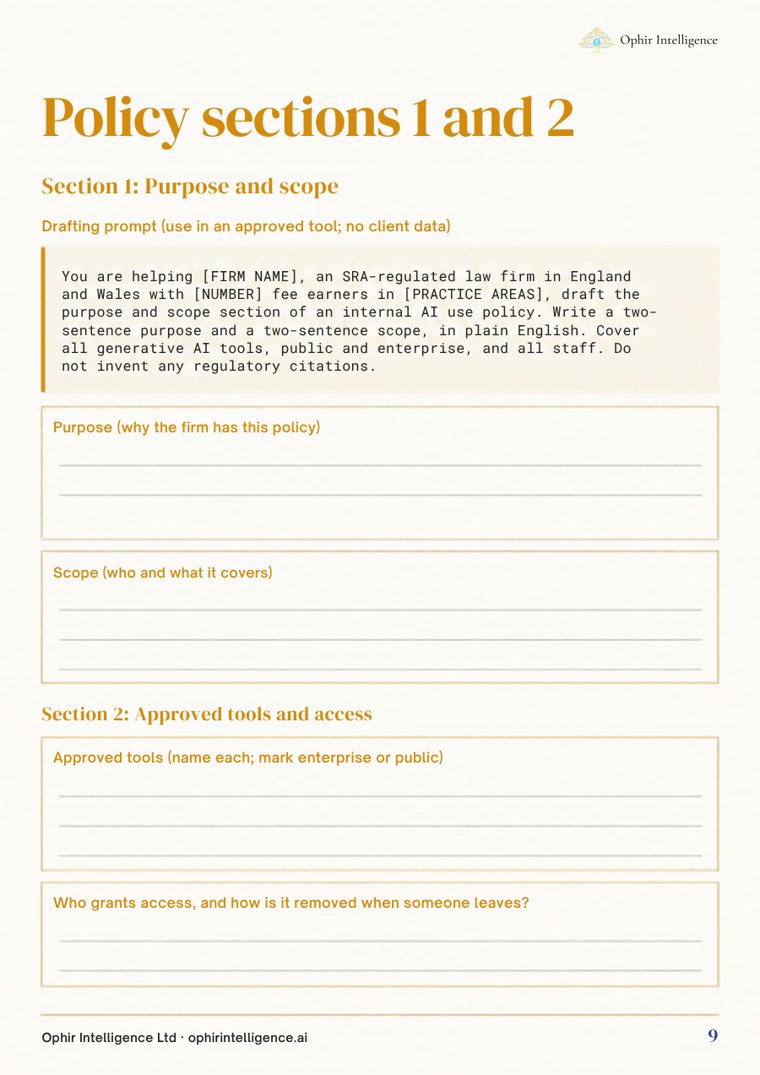
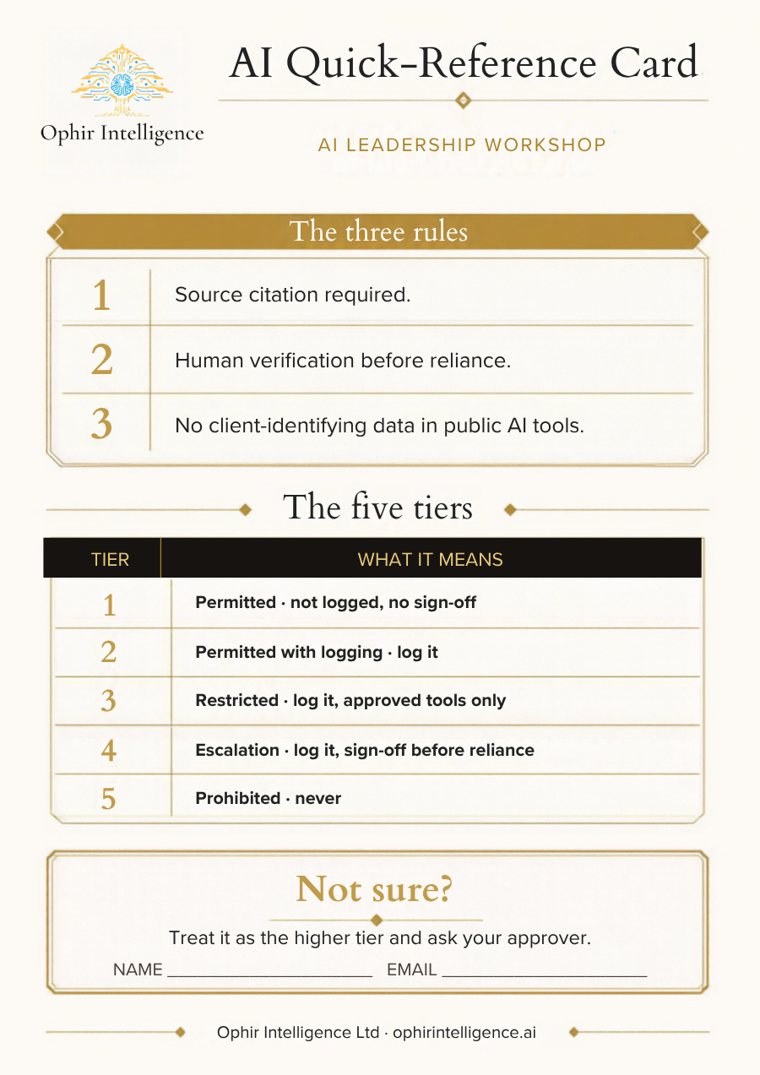
Every AI use in a firm fits one of five tiers. The tier decides two things: whether you log it, and who signs it off. It is the spine of the workshop and of your policy.

Adjei builds custom AI systems for SRA-regulated law firms, taking one high-value workflow from scope to production. That is why the workshop is practical rather than theoretical: the rules it teaches are the rules he builds to. Verify before anyone relies on it. Keep client data out of public tools. Log what matters, and put a name on the review.
The session is not a lecture on how large language models work. It is your leadership team, your real uses of AI, and your firm's documents, written in the room.
Where AI is used in your firm now, who would attend, and whether a half or full day fits. If the workshop is not the right step, we say so on the call.
Three short questions beforehand, so the examples in the room are your firm's, not generic ones. The workbook arrives personalised with your firm's name.
Written comments on your drafted policy within five working days. Then a 45-minute implementation clinic at day 30 with your named owners.
The same fee for every firm, stated here before you call.
Where AI is used in your firm today, and whether a workshop is the right next step.
Your leadership team drafts the policy, classifies AI use, designs the log and assigns the rollout.
The half day, then an afternoon on three live workflows your firm brings. The group classifies each one and writes working prompts for it.
The workshop trains the people. Ophir also builds AI infrastructure inside law firms, which is a different engagement with its own page. Nobody pitches it in the workshop room.
Anything not covered here is what the discovery call is for.
A free 30-minute call. We talk about how AI is used in your firm today and whether a workshop is the right next step, even if it turns out not to be with us.
Every enquiry answered personally by Adjei · Delivered across the UK